
Center for Family Consultation’s Midwest Symposium...
is always a highlight of the year. We are delighted this year to welcome Sarah Blaffer Hrdy as our guest scientist. This tribute from anthropologist, Melvin Konner, captures the significance of Dr. Hrdy’s contributions to the study of mating and parenting behavior in both the animal and the human world:
Sarah Blaffer Hrdy is one of the most original and influential minds in evolutionary anthropology. She first became known for her field study of Hanuman langurs, the sacred monkeys that range widely in the Indian peninsula. They are large and sometimes dangerous, and Hrdy was among that second generation of bold primatologists, just behind Jane Goodall and Diane Fossey, who did original work with primates. (Konner, 2011)
A main focus for Dr Hrdy’s research and writing is male-female relationships and reproduction across species. With this, she creates a foundation for understanding our human reproductive system. A striking difference between humans and our mammal and primate cousins is the frailty of the human infant and the resulting need for care beyond what mothers alone can provide, even with a helpful mate. In her book, Mother Nature: A History of Mothers, Infants, and Natural Selection, Hrdy asks: “Just who besides mothers subsidized the long, slow development that is the hallmark of the human species, the very late maturation that distinguishes us from every other primate?” (Hrdy 1999, 265). Calling them “alloparents,” she identifies close kin who provide care in the process called “cooperative breeding.” Based on study of hunter-gatherer societies, she points first to “a very special type of alloparent—postmenopausal females” (Hrdy 1999, 267).
Grandmothers are still often the first line of help but many members of the family are well-qualified candidates.
In her next book, Mothers and Others: The Evolutionary Origins of Mutual Understanding (2009), Hrdy expands on the intricacies of cooperative breeding and proposes that this is the source of the human capacity for understanding others. With the concept of “cooperative breeding,” she addresses an important evolutionary step that has made us, in Melvin Konner’s words, “the most cooperative primate species by far.” (Konner 2016, 185). It is easy to see why Dr. Hrdy’s work has been of great interest to students and scholars of Bowen theory. This way of thinking about the family resonates with Murray Bowen’s view of the family as a multigenerational emotional system.
Intrigued by recent discoveries that show that men respond to intimate involvement with babies the same way as mothers do, as measured by hormone levels and brain scans, Dr. Hrdy embarked on a study of fatherhood that matches the scientific rigor of her work on motherhood.
In her new book, Father Time: A Natural History of Men and Babies (2024), Hrdy takes the reader through the biological and cultural evolution of male care and notes that its expression in humans is far greater than that seen in most other species. With personal examples from her own family, she illustrates the caregiving of fathers, emphasizing that it is close engagement that elicits their attunement to the needs of the infant. She calls this essential closeness “time in intimate proximity” or TIP. Of equal importance would be the bond between father and mother and mother’s support of father’s involvement.
A fascinating chapter is devoted to detailed histories of several societies, describing the range of attitudes and cultures that have shaped gender roles. Hrdy identifies the conditions in societies that have been conducive to paternal care or more often, have assumed that mothers are designed to be the primary caregivers with fathers in a more distant position. Looking at our present society Hrdy writes: “All we can know for now is that there is an unexpected convergence of social, economic, technological, and cultural factors setting the twenty-first century stage so that some men spend more time with babies and actually care for them. …The staying power of such trends is far from guaranteed.” There is rich guidance here for those who are invested in creating a social environment that fosters the development of the caregiving potential of fathers.
-Stephanie Ferrera
References
Hrdy, S. B. 1999. Mother Nature: A History of Mothers, Infants, and Natural Selection. New York: Pantheon link
Hrdy, S. B. 2009. Mothers and Others: The Evolutionary Origins of Mutual Understanding link
Hrdy, S. B. 2024. Father Time: A Natural History of Men and Babies. Princeton: Princeton University Press link
Konner, M. 2011. “It Does Take a Village.” New York Review of Books link
Konner, M. 2015. Women After All. New York, W. W. Norton link
Registration is Open for the 43rd Annual Midwest Symposium
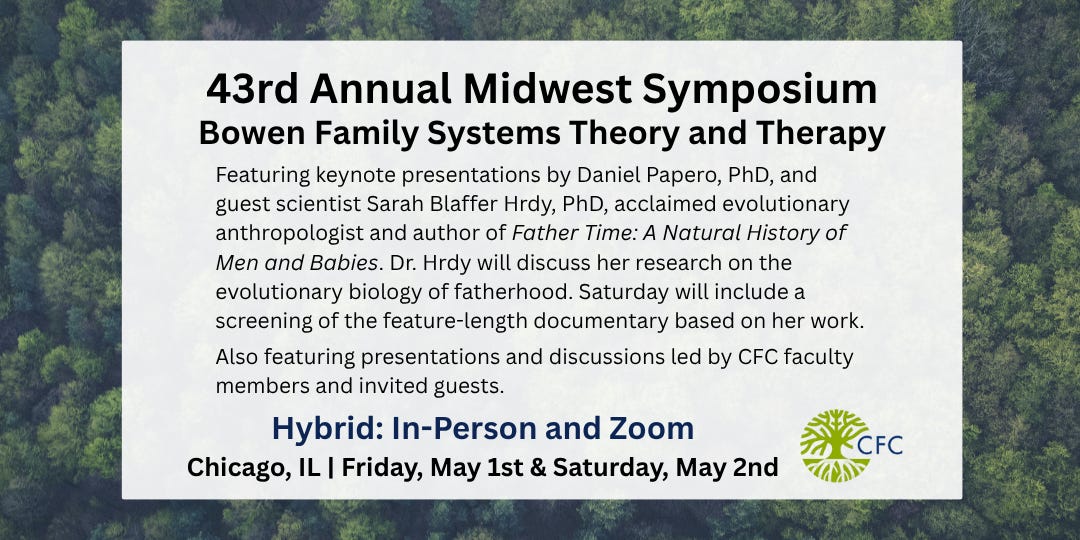
Established in 1984 with Dr. Murray Bowen as the sole presenter, the symposium has evolved to feature Dan Papero, PhD, as the primary speaker and, since 1990, a guest scientist each year. The event ensures Bowen family systems theory remains grounded in the natural sciences by inviting experts from fields such as neuroscience, evolutionary biology, and primatology. Single or two day tickets available:
Register Now Via Eventbrite
For a complete program description including full schedule see: CFC program page
CFC Program Spotlight:
Post Graduate Training Program in Bowen Theory
Understand the eight concepts of Bowen Theory, apply theory in practice through case studies and consultation, stay current with natural systems research, and explore one’s family of origin with expert guidance.
A continuous, immersive program from September 2026 to June 2027.
Monthly sessions (first Fridays, 9:00 a.m. – 4:30 p.m. Central Time) via Zoom.
Includes lectures, videos, discussions, case studies, and family of origin consultations.
Tuition: $2400 (2026-2027), Application fee: $50 (non-refundable).
72 CEUs upon completion of a full year.
Certificate of completion after two years of full attendance and completed assignments.
Applications accepted now through August 1, 2026.
Space is Limited - Contact John Bell for more information
What are CFC Faculty Reading and Viewing?
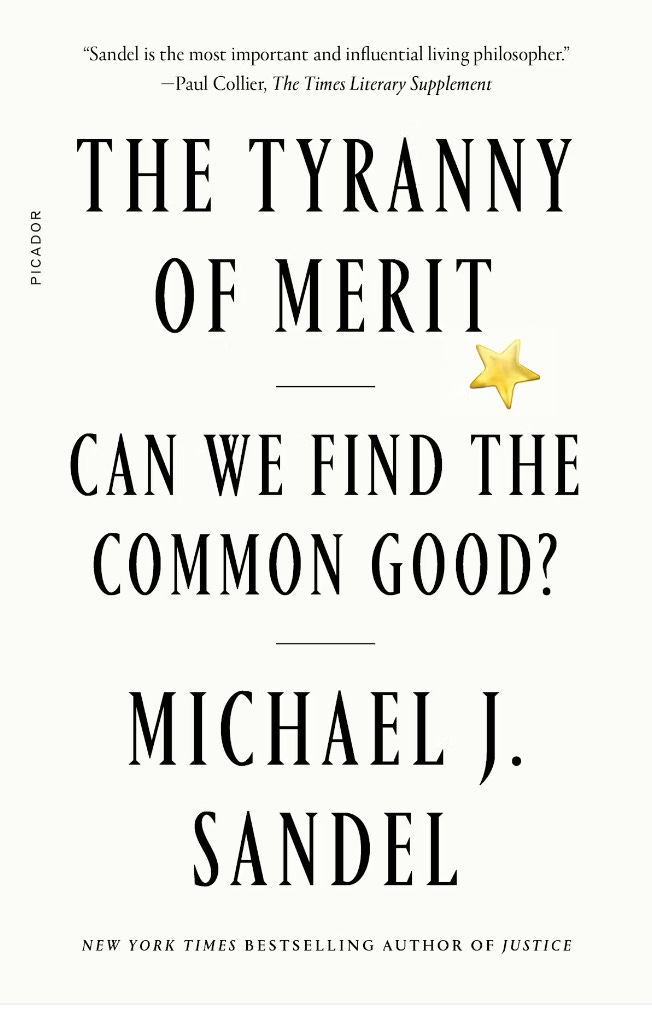
Cecilia Guzman, LCPC recommends The Tyranny of Merit by Michael Sandel published in 2020
In an era of rising inequality and social fragmentation, Michael Sandel’s work serves as a philosophical post-mortem of the “American Dream.” He examines how the promise of upward mobility has transformed into a tool of social division, questioning whether a system based on “merit” can ever truly be just.
Sandel offers a provocative critique of the modern “meritocratic ideal.” He argues that the belief that success is solely a result of individual effort and talent—and that everyone has an equal chance to rise—has created a deeply polarized society.
Sandel contends that this system fosters hubris among winners, who believe they earned their status alone, and humiliation among those left behind. By shifting the focus from the “common good” to individual credentialism, meritocracy erodes social solidarity and devalues the dignity of work for those without college degrees. Ultimately, Sandel calls for a reassessment of how we define success to heal our fractured democracy. Not necessarily an easy book to read but worth the time! more >

John Bell, MDiv recommends Elevator Systems podcast
I’ve been listening to the Elevator Podcast series hosted by the Living Systems counseling center in Vancouver, BC. You can explore their full library of resources on their website.
Their most recent episode features an insightful discussion about Artificial Intelligence with Dr. Patrick Stinson. It is a very relevant conversation for therapists currently exploring how AI might be useful within their clinical practice. Dr. Stinson is a pioneer in this space, having developed the first AI-based tool designed to provide feedback on family diagrams.
The episode is also highly practical for clinicians whose clients are now bringing their own AI-generated conversations into therapy sessions. Midway through the podcast, the dialogue shifts to explore the value of thinking alongside others and the various trade-offs of thinking within large groups. It really highlights the challenge of how to best integrate AI while preserving the vital “thinking” that happens within our human relationships. more >

Terri Pilarski, MDiv, LCSW recommends the television series Shrinking, streaming on Apple TV.
Apple TV’s hit series Shrinking tells the story of a psychotherapy practice and the efforts of this team of therapists, their family members, and their clients as they navigate life’s challenges of grief and loss.
Starring Harrison Ford, Jason Segel, Jessica Williams, Christa Miller, and other delightful actors, the series is lighthearted yet captures the characters’ efforts to navigate illness, death, job loss, addiction, and other challenges with depth and insight. Originally designed for three seasons, the series has been renewed for a fourth season, described as taking a leap into the future as the characters grow through the challenges they face.
From a Bowen Family Systems Theory perspective, Shrinking vividly portrays emotional process—the ways individuals both shape and are shaped by their relationships—highlighting the tension between reactivity and thoughtful connection as each character struggles to hold steady in the face of loss. more >

Sydney Reed, MSW recommends the memoir, Raising Hare written by Chloe Dalton
A New York Times Bestseller and finalist for the 2025 Women’s Prize, Raising Hare is a remarkable story of political consultant Chloe Dalton’s rescuing of a newborn hare (aka, jack rabbit) in the English countryside where she lives part time. Determined to not make the hare a pet but to merely help it survive, she allows the hare to take the space and food it needs. A wonderful example of the ability to let another creature determine its own fate in spite of the attachment you may feel and the urge to over protect. more >
Save the Date for CFC’s Summer Conference
The Center for Family Consultation’s 2026 Summer Conference is scheduled for Friday, July 10, 2026. This year’s event will be held virtually (online only), featuring Dr. Kathleen Smith as the guest presenter.
For more information, contact Stephanie Ferrera, MSW.